




From fraud detection to hyper-personalized wealth management, autonomous AI agents are rewriting the rules of modern financial services — permanently.
The banking industry has always been an early adopter of transformative technology — from ATMs in the 1960s to internet banking in the 1990s. Today, a new inflection point is underway. Agentic AI in banking represents not just an upgrade, but a fundamental reimagining of how financial institutions operate, compete, and serve customers.
Unlike earlier generations of AI that simply flagged anomalies or answered FAQ chatbots, agentic AI systems can reason, plan, and act autonomously across complex multi-step workflows. For banks, this is a seismic shift.
“Agentic AI doesn’t just answer questions — it takes action, monitors outcomes, and iterates. In banking, that changes everything from compliance to customer experience.”
What Is Agentic AI in Banking?
Agentic AI refers to AI systems that operate with a degree of autonomy — setting sub-goals, using tools, calling APIs, and completing multi-step tasks without continuous human input. In the context of financial services, these AI agents can be deployed across the entire value chain: from onboarding and underwriting to portfolio management and regulatory reporting.
The key distinction between agentic AI and traditional machine learning models is agency. A traditional ML model predicts credit risk. An AI agent assesses risk, sources additional verification data, routes the application through approval workflows, and notifies the applicant — all autonomously.
Top Use Cases: Agentic AI Transforming Financial Services
Real-Time Fraud Detection
AI agents monitor transactions 24/7, flag anomalies, freeze accounts, and escalate — in milliseconds.
Automated KYC & Onboarding
Agentic pipelines verify identity documents, cross-check sanctions lists, and open accounts end-to-end.
AI-Driven Wealth Management
Autonomous advisors rebalance portfolios, harvest tax losses, and personalize investment strategies at scale.
Intelligent Loan Underwriting
AI agents assess creditworthiness using alternative data sources, reducing approval times from days to minutes.
Conversational Banking Agents
Next-gen virtual assistants handle disputes, transfers, and financial planning — not just basic FAQs.
Regulatory Compliance Automation
AI continuously monitors transactions, generates audit trails, and files regulatory reports automatically.
The Rise of Autonomous Financial Agents
Autonomous AI agents in finance are rapidly moving from pilot programs to core infrastructure. JPMorgan Chase’s LLM-based contract analysis tool reportedly does the work of 360,000 hours of human labor annually. Goldman Sachs and Morgan Stanley have deployed AI copilots that assist analysts in research generation and data synthesis.
But the real disruption is happening at the operational layer. Banks are now deploying multi-agent AI systems — networks of specialized AI models that collaborate. One agent handles document extraction, another performs risk scoring, a third routes for human review only when confidence is low. The result is a dramatic compression of cycle times and operational costs.
Key Benefits of Agentic AI for Banks
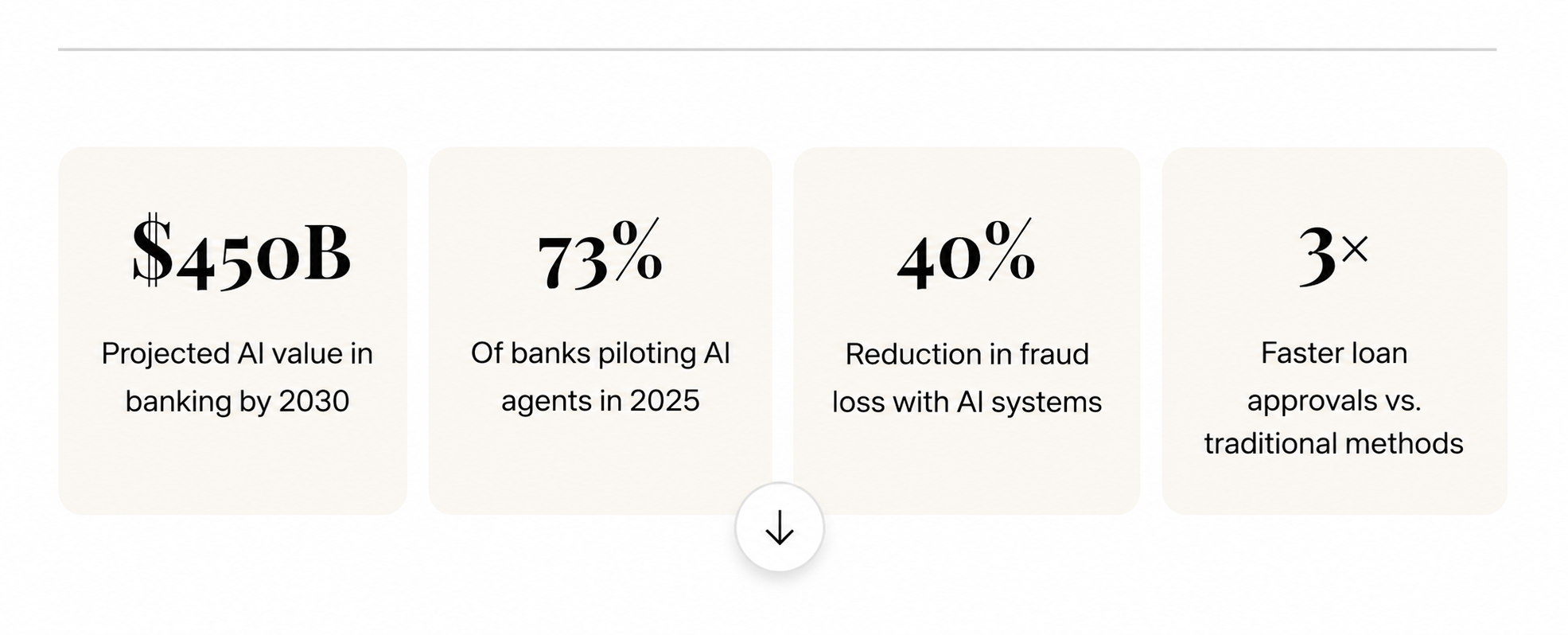
The business case for AI-powered banking transformation is compelling across multiple dimensions:
Strategic Insight
McKinsey estimates that generative and agentic AI could deliver between $200 billion and $340 billion in annual value for the global banking sector — primarily through productivity gains in customer operations, risk management, and software engineering.
Beyond cost reduction, AI personalization in banking is unlocking revenue. Hyper-personalized product recommendations, proactive financial coaching, and contextual nudges — delivered by AI agents that know each customer’s full financial picture — are showing conversion rates 4–6× higher than batch-and-blast marketing.
Challenges: Navigating Risk in AI-Driven Banking
The responsible deployment of AI in financial services comes with significant challenges. Regulators in the EU, US, and UK are actively developing frameworks for AI governance in banking — covering explainability, bias auditing, and human oversight requirements.
Model risk management takes on new complexity with agentic systems, since their behavior is emergent and harder to audit than a fixed decision tree. Banks must invest heavily in evaluation infrastructure, adversarial testing, and human-in-the-loop escalation mechanisms for high-stakes decisions.
Data privacy is another critical dimension. Agentic AI systems require access to rich customer data to function effectively — creating tension with GDPR, CCPA, and sector-specific data protection requirements. Privacy-preserving AI techniques like federated learning and differential privacy are emerging as key enablers.
The Future: Toward the Autonomous Bank
Looking ahead, the trajectory points toward what analysts are calling the “autonomous bank” — an institution where AI agents handle the majority of routine operations, human bankers focus on complex judgment and relationship work, and the customer experience is seamlessly personalized in real time.
AI-native challenger banks are already building on this architecture from day one. Established institutions that fail to adopt agentic AI banking solutions risk falling behind not just on efficiency, but on the product experiences that define customer loyalty in an increasingly digital-first world.
The banks that will win the next decade are those investing today in three areas: AI agent infrastructure, governance frameworks for autonomous systems, and the organizational culture to deploy AI responsibly at scale.
Bottom Line
Agentic AI is not a future possibility for banking — it is an active, accelerating transformation happening right now. From real-time fraud prevention to autonomous underwriting and hyper-personalized wealth management, AI agents are becoming the operational backbone of modern financial institutions.
The question for banking leaders is no longer whether to adopt agentic AI, but how fast and how responsibly to do so. The competitive gap between leaders and laggards is widening with every quarter.Explore AI fraud detection ↗
