




How autonomous AI agents are transforming every touchpoint—from hyper-personalization and 24/7 support to proactive service—and what it means for your business in 2025 and beyond.
Customer experience has always been the competitive battleground—but the weapons have changed. We’ve moved from call centers to chatbots, from email queues to live chat. Now, the next seismic shift is here: agentic AI, systems capable of autonomous decision-making, multi-step reasoning, and proactive action without constant human prompting.
This isn’t incremental improvement. It’s a fundamental reimagining of how businesses interact with the people they serve. In this post, we explore what agentic AI means for customer experience, where the technology is headed, and how forward-thinking organizations are already deploying it to drive measurable results.
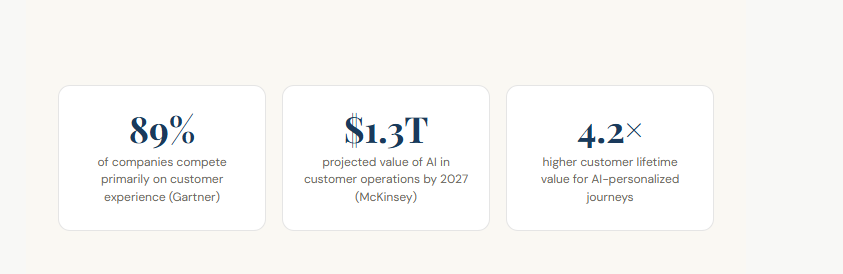
What Is Agentic AI — And Why Does It Matter for CX?
Traditional AI in customer experience was reactive: a customer asks a question, the bot answers from a script. Agentic AI is a quantum leap forward. These are AI systems that can set goals, plan multi-step workflows, use tools, access external data, and execute tasks end-to-end—often with little or no human intervention.
Think of the difference between a FAQ bot and an AI agent that detects a shipping delay, automatically contacts the affected customer with a proactive update, offers a discount, reschedules delivery, and logs the interaction for future personalization—all before the customer even realizes there’s a problem.
“Agentic AI doesn’t just answer questions. It anticipates needs, takes action, and learns continuously—turning every customer interaction into an opportunity for deeper loyalty.”
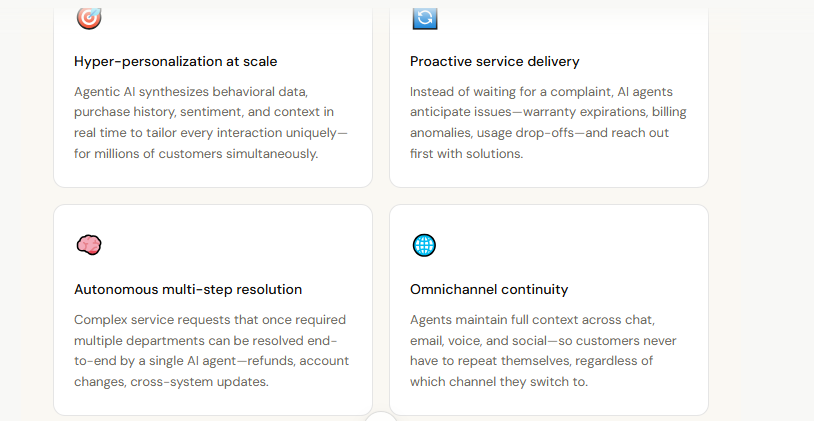
Key Capabilities Reshaping Customer Experience
Real-World Use Cases Already Delivering ROI
Retail & E-commerce
Intelligent post-purchase support agents
Leading retailers deploy AI agents that monitor every order in transit, identify at-risk deliveries, and autonomously trigger resolution workflows—issuing refunds, reordering items, or escalating to human agents—before customers file a complaint. Average handle time drops by 60%, CSAT scores climb.
Financial Services
Proactive financial wellness advisors
Banks use agentic AI to scan spending patterns, flag potential overdrafts, suggest product upgrades, and guide customers through complex loan applications—adapting tone and recommendations to individual risk profiles and life events.
Healthcare
Continuous patient engagement and follow-up
Healthcare providers deploy agents that follow up post-appointment, answer medication questions, schedule follow-ups, and alert care teams to concerning symptom changes—extending the care relationship beyond the clinic walls.
SaaS & Tech
AI-native customer success at scale
Software companies use agentic AI to monitor product usage, identify churn signals, deliver in-app guidance, and orchestrate upsell conversations—all automatically, with human CSMs focusing only on strategic accounts.
The Human-AI Partnership: Augmentation, Not Replacement
One of the most important shifts in the agentic AI era is the redefinition of human roles in CX. Agents don’t replace human empathy—they amplify it. By offloading repetitive, high-volume tasks, agentic AI frees human agents to handle emotionally complex cases, build deeper relationships, and exercise judgment that machines can’t replicate.
The most successful CX organizations are building hybrid intelligence models: AI handles volume, humans handle complexity. Smart routing algorithms ensure the right issues reach human agents, already pre-researched and summarized by AI. The result is faster resolution and higher satisfaction—for customers and for employees.
“The best customer experiences of tomorrow will be invisible—frictionless, predictive, and effortlessly human in feel, even when AI is doing most of the work.”
Challenges and Considerations for CX Leaders
⚠️Trust and transparency
Customers are increasingly aware of AI in service interactions. Organizations must balance automation with clarity—disclosing when AI is operating and ensuring escalation paths remain accessible.
🔐Data privacy and compliance
Hyper-personalization requires rich data. CX leaders must navigate GDPR, CCPA, and emerging AI regulations while building data architectures that enable intelligence without compromising privacy.
🔗System integration complexity
Agentic AI is only as powerful as the systems it can access. Legacy CRM, ERP, and ticketing systems often create integration bottlenecks that slow deployment and limit autonomous action.
📏Measuring the right metrics
Traditional CX metrics like CSAT and NPS capture only part of the picture. Organizations need to evolve measurement frameworks to capture proactive deflection, lifetime value impact, and AI-assisted resolution quality.
What to Expect in the Next 3–5 Years
The agentic AI trajectory in customer experience points clearly toward a few defining trends. Voice-first agentic assistants will become the dominant service channel, surpassing text chat as natural language processing reaches near-human fluency. Emotionally intelligent AI—systems that detect and respond to customer sentiment with genuine adaptability—will shift from novelty to table stakes. Predictive CX will see AI anticipate customer needs across their entire lifecycle, not just individual service events.
Perhaps most transformatively, the line between marketing, sales, and service will dissolve. A single agentic AI layer will orchestrate the entire customer relationship—from first awareness through post-purchase loyalty—as one continuous, intelligent conversation.
.
