




An employee asks an AI assistant about the enterprise refund policy. In seconds it returns a confident, polished answer — a clause, a threshold, an approval step. Every detail is wrong. The assistant wasn’t broken; it just sounded right instead of actually being right.
That gap between fluent and factual is the AI hallucination problem, and in 2026 it’s no longer a research curiosity — it’s a measured enterprise risk. According to Vectara’s Hughes Hallucination Evaluation Model (HHEM) leaderboard, leading models still hallucinate on roughly 3–15% of controlled benchmark tasks. The lesson for leaders: you can’t wait for a perfect model. Reliability has to be engineered around it — and it can be.
Why AI systems and agents hallucinate
Foundational models learn broad language patterns and general knowledge. They do not inherently understand an organization’s proprietary data, operating procedures, risk appetite, product hierarchy, approval structure, customer entitlements, or regulatory obligations.
That enterprise context is also rarely available in one clean repository. It is fragmented across databases, documents, workflow tools, applications, emails, policy libraries, and employees’ experience. The same term may have different definitions across business units. A valid rule may apply only to one region, product, customer segment, or reporting period. Those two problems — missing enterprise knowledge and fragmented data — are what set the stage for confident, but wrong answers.
The real cost of context-bind AI
An agent that fabricates a policy detail, misreads a regulatory constraint, or invents a number doesn’t just produce a wrong answer — it triggers compliance exposure, erodes stakeholder trust, and sends teams into costly rollback and rework cycles.
This is why so many initiatives stall. Gartner estimates that more than 50% of generative AI projects are abandoned after the proof-of-concept stage— not because the models are weak, but because organizations can’t make them reliable enough to trust with real decisions. Without sufficient context, AI agents cannot operate accurately and are far more likely to hallucinate, introduce bias, and produce unreliable results.
Why better models, prompts, and RAG can’t close the context gap
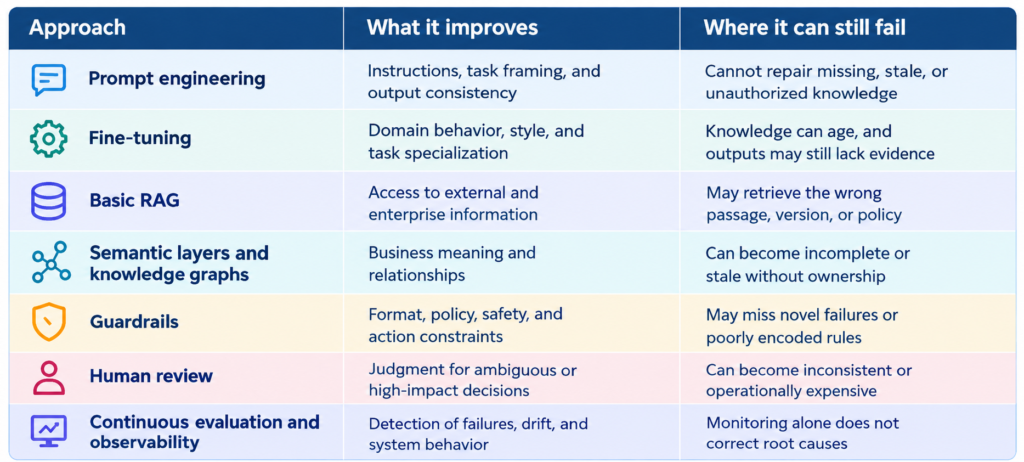
Prompt engineering can clarify instructions, constrain format, and encourage the model to use evidence. Fine-tuning can improve behavior for a defined domain or task. Retrieval-augmented generation (RAG) can provide external evidence at inference time rather than depending entirely on information encoded during model training.
Each technique is valuable. None is sufficient by itself.
RAG, for example, can still produce incorrect answers when retrieval returns irrelevant, incomplete, contradictory, or outdated material. A systematic review of RAG research found recurring challenges involving retrieval quality, grounding fidelity, robustness, and evaluation, with trade-offs between retrieval precision, generation flexibility, faithfulness, efficiency, and coordination.
The Context Gap, explained
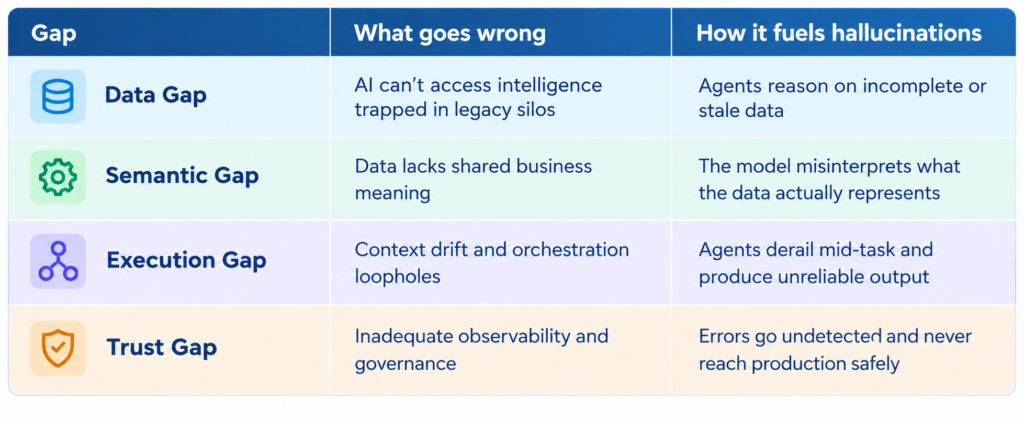
Every hallucination traces back to the same source — the distance between what a foundational model knows about the world and what makes your enterprise unique: your proprietary data, business rules, policies, risk tolerance, and ways of working. This is defined as the Context Gap, and it has four distinct layers.
Proven ways to reduce AI hallucinations
If the Context Gap is the root cause of hallucinations, how do enterprises actually close it? Because the gap has four distinct layers, a systematic, holistic approach is required. Each layer demands its own deliberate move — and together they form a layered defense that no one technique can replicate.
1. Modernize and unify the data foundation: Liberate data from legacy silos so agents can reason over complete, current information instead of fragmented snapshots. This closes the Data Gap.
2. Engineer a semantic layer: Build the knowledge graph, ontology, and business definitions that encode meaning — how entities relate, which rules apply, what terms actually mean. This is what turns a generic AI model into a domain expert and closes the Semantic Gap.
3. Orchestrate governed agent workflows: Compose multi-agent processes that route, reason, and complete real tasks with the right slice of context delivered at the right moment — closing the Execution Gap before drift sets in.
4. Observe and govern in production: Instrument every agentic decision with drift detection, evaluation, and guardrails so errors surface early. This closes the Trust Gap and keeps accuracy durable at scale.
Closing this gap isn’t a model-selection problem. It requires a new engineering discipline: context engineering.
How context engineering enables trusted AI
Reducing hallucinations reliably comes down to four disciplined moves — a loop, not a one-time fix. The methodology that operationalizes this is the Context Engineering Delivery Lifecycle (CEDL) — a loop in which every phase ends on evidence, not confidence.
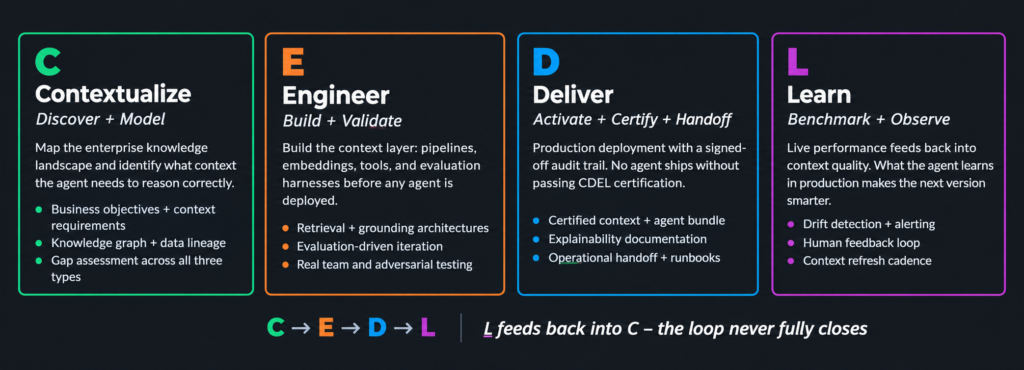
Contextualize: Define the business objective and identify the data, knowledge, relationships, permissions, rules, and constraints the system requires.
Engineer: Build and validate the context layer, retrieval pipelines, tools, evaluation harnesses, and guardrails.
Deliver: Deploy with defined certification criteria, explainability, accountability, audit evidence, and operational controls.
Learn: Monitor production outcomes, detect drift and failure patterns, and use them to improve context and system behavior.
The Learn stage feeds back into Contextualize, so each iteration makes the next one sharper.
The bottom line
The difference between a fragile prototype and a reliable enterprise system is accountability. Mature context engineering treats evaluation-driven development as non-negotiable: every phase produces a measurable proof point before the next begins, and no agent reaches production without a signed-off context bundle, an evaluation record, and an explainability trace. When learning from production feeds back into the context layer, each version of the agent gets smarter — and less prone to hallucinate — than the last.
This is the approach Impetus Technologies operationalizes through its Leap™ AI Solutions & Services Family — modernizing fragmented data estates, engineering an enterprise context layer that eliminates hallucination at the source, orchestrating intelligent workflows, and governing agents that report >95% accuracy and zero context drift in production. The organizations that define the next decade of enterprise AI won’t be the ones that picked the best model — they’ll be the ones that solved the Context Gap first.
